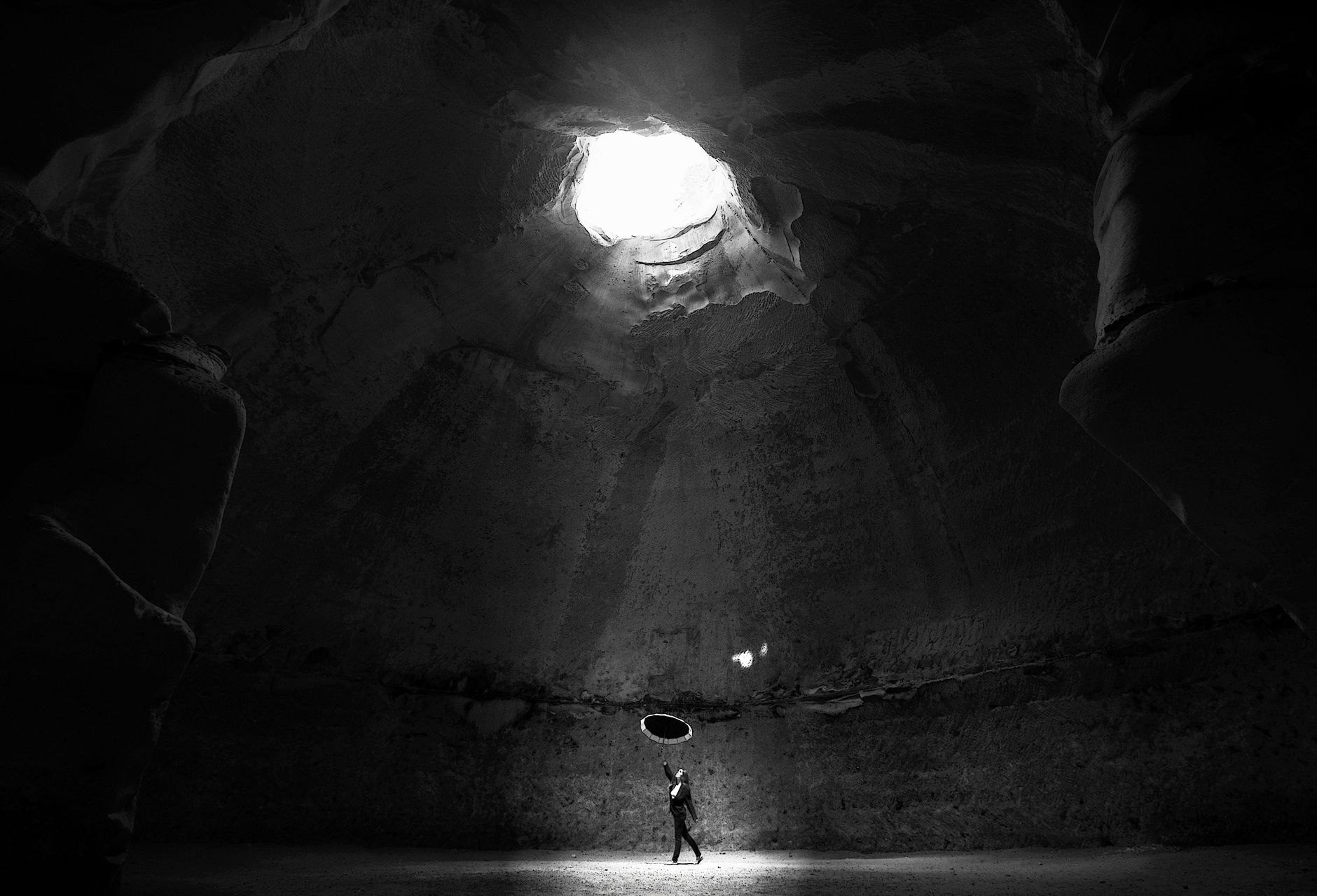
Five days in absolute darkness — what happened to her body and mind
The experiment: engineered solitude as a data platform
Kiana Aran, a bioengineer at the University of California, San Diego, reportedly spent five days alone in an underground “ultimate darkness” retreat in rural Poland to test what happens when nearly all external stimuli are removed. It has been reported that she entered the site with continuous monitors — a Neuroverse wireless EEG, an Oura Ring, a continuous glucose monitor — and that her team collected blood, saliva, urine, skin and stool for proteomic, metabolic and microbiome analysis before, during and after the stay. This was not a meditation retreat dressed up as science: it was a high-resolution, single-subject physiological experiment built on decades of “reduced environmental stimulation” (REST) research.
REST, expectations and method
REST comes in different forms: Chamber-REST (quiet, dark, enclosed rooms) and Flotation-REST (floating in salt-saturated pools). Clinical researchers such as Justin Feinstein have shown short flotation sessions can reduce anxiety and lower blood pressure. But what happens if you scale duration, measurement density and isolation? Calm or collapse? Aran’s setup removed light, reliable time cues, regular social contact and predictable schedules, while preserving physical comfort and basic needs — meals were passed through a light-proof hatch and delivery times were deliberately scrambled to deny time anchors.
Physiological and perceptual rewiring
It has been reported that the results were complex and sometimes counterintuitive. Sensory channels that remained available — taste, smell, touch — reportedly became heightened; proteomic analyses allegedly showed changes in receptors linked to taste and olfaction. Sleep–wake rhythms “free-ran,” with EEG and Oura data indicating phase drift and REM-like activity during daytime; dreamlike imagery and vivid family scenes reportedly emerged. Metabolically, her continuous glucose trace was unusually stable after meals and proteomics suggested upregulation of GLUT4-style glucose transport mechanisms. Immune markers showed early activation, and microbiome sampling reportedly found rapid shifts on skin and in saliva while gut communities remained comparatively stable. Together these signals suggest the body treats abrupt removal of environmental cues as a change worth compensating for — sometimes by amplifying remaining signals, sometimes by activating stress-defense systems.
What this means — and what it does not
The key takeaway: removing external stimulation does not automatically equal serenity. Reduced input can unmask compensatory neural prediction, metabolic rebalancing and even immune responses. It has been reported that Aran framed the retreat as “networking the inner world,” but this single-subject, high-intensity experiment cannot be extrapolated to general clinical practice. Still, the findings speak to broader questions for sleep and mental-health therapies, for people pursuing digital detoxes, and for designers of sensory-deprivation interventions: when you deprive the brain of its usual calibration signals, it will recalculate — sometimes toward rest, sometimes toward instability.